Interstellar travel is slow, because the distances between the stars are so long. Even our nearest star, Proxima Centauri, is over 4 light-years away - meaning that light, the fastest thing in the universe, would take more than 4 years to travel there. Our fastest spacecraft today would take hundreds of thousands of years to arrive at Proxima Centauri.
But what if we could take a ride on spacetime itself? We know from cosmological research that spacetime isn’t itself subject to the cosmic speed limit, c: in fact, the most distant galaxies are receding from us faster than the speed of light. In theory, a spacetime geometry (albeit one unlike anything we see naturally in the universe) could allow for the possibility of faster-than-light interstellar travel. One such metric is the Alcubierre metric. By causing the expansion of spacetime in front of, and the contraction of spacetime behind, an isolated “shell region” of spacetime, the metric allows the “shell region” to move at an arbritrary speed. We will explore the mathematics of the Alcubierre metric in this chapter: both as a way to better understand general relativity, and to answer the question: is it possible to build a warp drive in reality?
It is important to note here that this derivation is not a “derivation” in the strictest sense. This is because the Alcubierre Metric is more so a constructed rather than derived metric found by solving the Einstein Field Equations for a specific stress-energy tensor.
Alcubierre constructed his metric from the general form of all metrics in the ADM formalism:
Where xs(t) is a function of the spacecraft’s position over time, and f(rs(t)) is a “top hat” shaping function to modify the metric such that it would vanish where rs>R, and “push” the spacecraft forward:
Finally, as the Alcubierre metric has no other terms other than the ones shown explictly in the sum, we can set all other terms in the sum to zero, so:
Here, we’ll derive the the spacetime expansion/contraction and energy density associated with the (original) Alcubierre metric. The magnitude of the expansion and contraction of space resultant from the metric is called the York Time. We can derive the York Time from the extrinsic curvature tensor, which is given by:
The above expression for the York Time gives the magnitude of the spacetime expansion and contraction, and we will refer to it with θ from this point on:
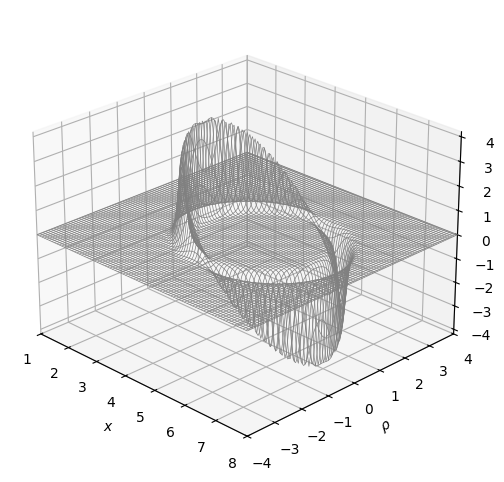
Below, a plot of the York time with vs=c, σ=8 and a 2-meter radius warp shell is shown:
import numpy as np
import matplotlib.pyplot as plt

def f_rs(r_s, sigma=8, R=2):
    return (np.tanh(sigma * (r_s + R)) - np.tanh(sigma * (r_s - R)))/(2 * np.tanh(sigma * R))

def df_rs(r_s, sigma=8, R=2):
    return (sigma * (np.tanh(sigma * (R - r_s)) ** 2 - np.tanh(sigma * (R + r_s)) ** 2)) / (2 * np.tanh(sigma * R))

def d_rs(x, rho, x_s=2.5):
    # rho is y and z "squashed together"
    return ((x - x_s)**2 + rho**2)**(1/2)

def theta(x, rho, x_s=2.5, v_s=1, sigma=8, R=2):
    drs = d_rs(x, rho, x_s)
    dfrs = df_rs(drs, sigma, R)
    return v_s * ((x - x_s) / drs) * dfrs

def alcubierre_plt(width, height, samples=160):
    x = np.linspace(1.0, 8.0, num=samples)
    p = np.linspace(-4.0, 4.0, num=samples)

    # Generate coordinate matrices from coordinate vectors.
    X, P = np.meshgrid(x, p)

    # Get york time
    Z = theta(X, P, x_s = 5)

    # Create the Figure.
    fig = plt.figure(figsize=(width, height))
    ax = plt.axes(projection='3d')

    # Set the angle of the camera
    ax.view_init(25, -45)

    # Add latex math labels.
    ax.set_xlabel(r'$x$')
    ax.set_ylabel(r'$\rho$')
    ax.set_zlabel(r'$\theta$')

    # Set the axis limits
    ax.set_xlim(1.0, 8.0)
    ax.set_ylim(-4, 4)
    ax.set_zlim(-4.2, 4.2)

    # Plot the Surface.
    ax.plot_wireframe(X, P, Z, rstride=2, cstride=2, linewidth=0.5, antialiased=True, color='gray')
    plt.show()

alcubierre_plt(12, 6)
Here, we can see that the metric induces a contraction of spacetime in front and an expansion of spacetime behind the spacecraft.
Now, we can calculate the energy density. Returning to the metric, we know that we can calculate the stress-energy tensor from the metric. Taking the first component of the stress-energy tensor - that is, T00 - yields the energy density:
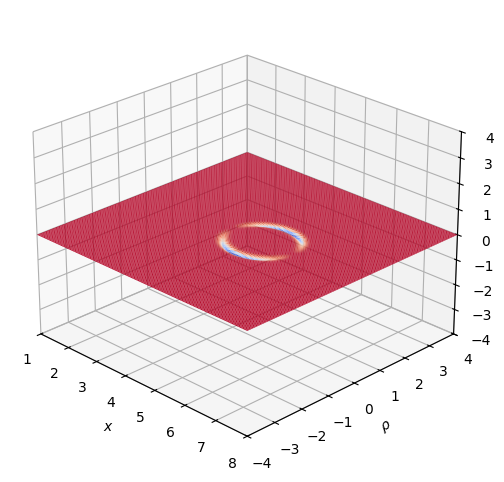
The energy density distribution is orthogonal to the direction of the spacecraft’s movement, as shown in the plot below:
def energy_density(x, rho, x_s=2.5, v_s=1, sigma=8, R=1):
    r_s = ((x - x_s)**2 + rho**2)**(1/2)
    drs = d_rs(x, rho, x_s)
    dfrs = df_rs(drs, sigma, R)
    return (-1/(8 * np.pi)) * ((v_s ** 2 * rho ** 2)/(4 * r_s ** 2)) * ((dfrs / drs) ** 2)

def energy_density_plt(width, height, samples=160):
    x = np.linspace(1.0, 8.0, num=samples)
    p = np.linspace(-4.0, 4.0, num=samples)

    # Generate coordinate matrices from coordinate vectors.
    X, P = np.meshgrid(x, p)

    # Get york time
    Z = energy_density(X, P, x_s = 5)

    # Create the Figure.
    fig = plt.figure(figsize=(width, height))
    ax = plt.axes(projection='3d')

    # Set the angle of the camera
    ax.view_init(25, -45)

    # Add latex math labels.
    ax.set_xlabel(r'$x$')
    ax.set_ylabel(r'$\rho$')
    ax.set_zlabel(r'$T_{00}$')

    # Set the axis limits
    ax.set_xlim(1.0, 8.0)
    ax.set_ylim(-4, 4)
    ax.set_zlim(-4, 4)

    # Plot the Surface.
    ax.plot_surface(X, P, Z, alpha=1, cstride=2, rstride=2, linewidth=0.1, cmap=plt.cm.coolwarm)
    plt.show()

energy_density_plt(12, 6, samples=320)
The energy density graph, unfortunately, disguises perhaps the most important issue with the Alcubierre metric: energy requirements. I will spare a full calculation of the energy requirements, but past research has shown that a 100-meter radius warp shell would require a total negative energy of:
For perspective, let’s consider an idealized version of the Casimir effect of quantum mechanics, which has been shown to produce negative energy densities in an experimental setting.
Given that a is the distance between the plates, we may calculate the force caused by the Casimir effect with:
While the Casimir effect is measured in N/m2, this is equivalent to J/m3, so the negative energy density eρ− of two plates separated by a distance of 1 micrometer would be approximately equal to:
Thus, a 60+ order-of-magnitude reduction is necessary to allow a functioning Alcubierre warp shell to be built, even assuming a large number of Casimir cavities arrayed together on the spacecraft.